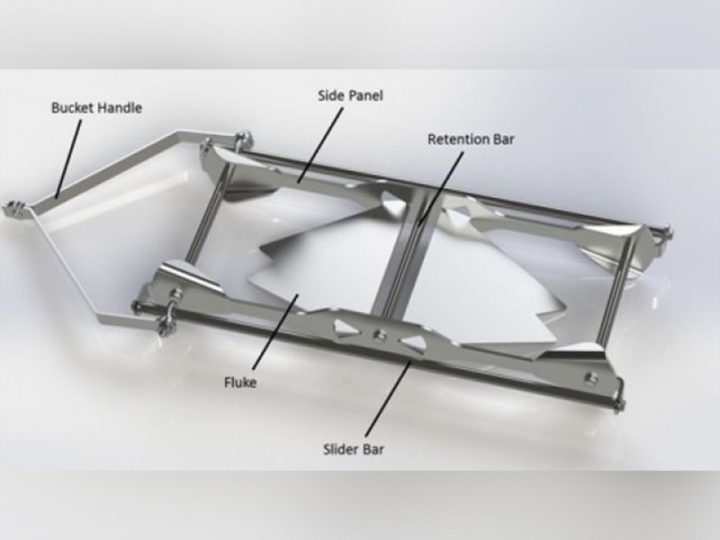
An innovative anchor technology that was recognised at the Seawork Innovation Showcase back in 2017 is now seeking funding to help take it to market.
Wednesday, 9th June 2021
It is well known that Inventors of brilliant ideas such as new anchor technology generally do not benefit from their inventions, usually due to a lack of funding that would enable them to progress the invention to market.
The Tidal Anchor® is an omnidirectional marine anchor developed to solve the problem of conventional anchors needing to be reset when the tide or wind changes direction.
This involves retrieving and redeploying the anchor, during which time the vessel will move off station. Due to the dragging length, considerable damage can occur to a fragile seabed environment before the traditional anchor becomes secure again and perhaps does not even set at all.
However, when deployed, the Tidal Anchor’s environmentally friendly, innovative design sets within its length and remains safely in position with a high holding capability, thus protecting a fragile seabed. Cardiff University carried out CAD modelling and FEA. After extensive tank, beach, and sea trials were undertaken (with support given by Swansea University through their Survey Vessel R.V.Noctiluca), the anchor has been developed into a secure, safe mooring solution for both leisure and working craft.
Once deployed, the anchor settles on the seabed attached to the vessel via a shackle through the Bucket Handle. The Flukes are free to rotate within the cut-outs in the Side Panels and hence move under their weight to rest with their tips on the seabed – the engagement angle is initially 16°. Loading the Bucket Handle (e.g. due to tidal/wind loading on the attached vessel) causes the front-facing Fluke to dig into the seabed – this is promoted by a funnelling effect caused by the claws in the Side Panel. Hence, the anchor buries itself into the sand, with the loading on the Fluke causing it to rotate into the maximum allowable position set by the Side Panel cutouts. The rear Fluke is also loaded and, therefore, contributes to the anchor’s holding power. Changing tides or wind conditions can vary the loading position, which causes the Bucket Handle to slide along the Slider Bars and re-engage on the opposing end – thus causing the rear-facing Fluke to engage.
This totally unique, innovative anchor technology design does not require structural welding during manufacture and is easily assembled.
To establish the novel design’s market potential, a demonstration model was entered and exhibited in the Innovation Showcase at Seawork International Exhibition 2017 in Southampton. It received a European Commercial Marine Innovation Award in the category of Marine Engineering and Construction.
Cardiff University is conducting a feasibility study into the viability of manufacturing the Tidal Anchor® in different material composites, e.g., carbon fibre, as a lightweight, non-reflective alternative for small inflatable craft. Patent Protection has now been granted in the UK, Hong Kong, U.S.A, Australia, China, Germany, and France.
Although the Tidal Anchor has shown great early potential, there is still a requirement for the project to go forward to market, where it’s anticipated there will be a strong demand. Funding to assist with this next stage is sought, and interested parties can find out more at www.tidalanchors.com