Pushing the boundaries: the role of innovative transferrable technology in delivering performance and accuracy
Thursday, 24th August 2017
Continued innovations in technology across all sectors go hand in hand with the adoption of new approaches and innovative ways of working, allowing manufacturers to keep pace with the increasing demands of customers in areas such as speed, accuracy and efficiency. Here, David Scholes, Systems and Engineering Manager at Bosch Rexroth, explains how the combination of the latest technologies and innovative thinking is pushing the boundaries to achieve tasks previously thought impossible.
The changing landscape of modern day industry has brought increasing demands, and with it greater challenges for manufacturers to remain competitive. Cost-efficiency has always been an important factor in business, however the world we live in now moves at an ever faster pace in almost every sphere of activity – and industry has to keep up. Whether the applications relate to installation and configuration, or an ongoing manufacturing process, any action which can be taken to save time and improve efficiency will be welcomed by system designers and engineers.
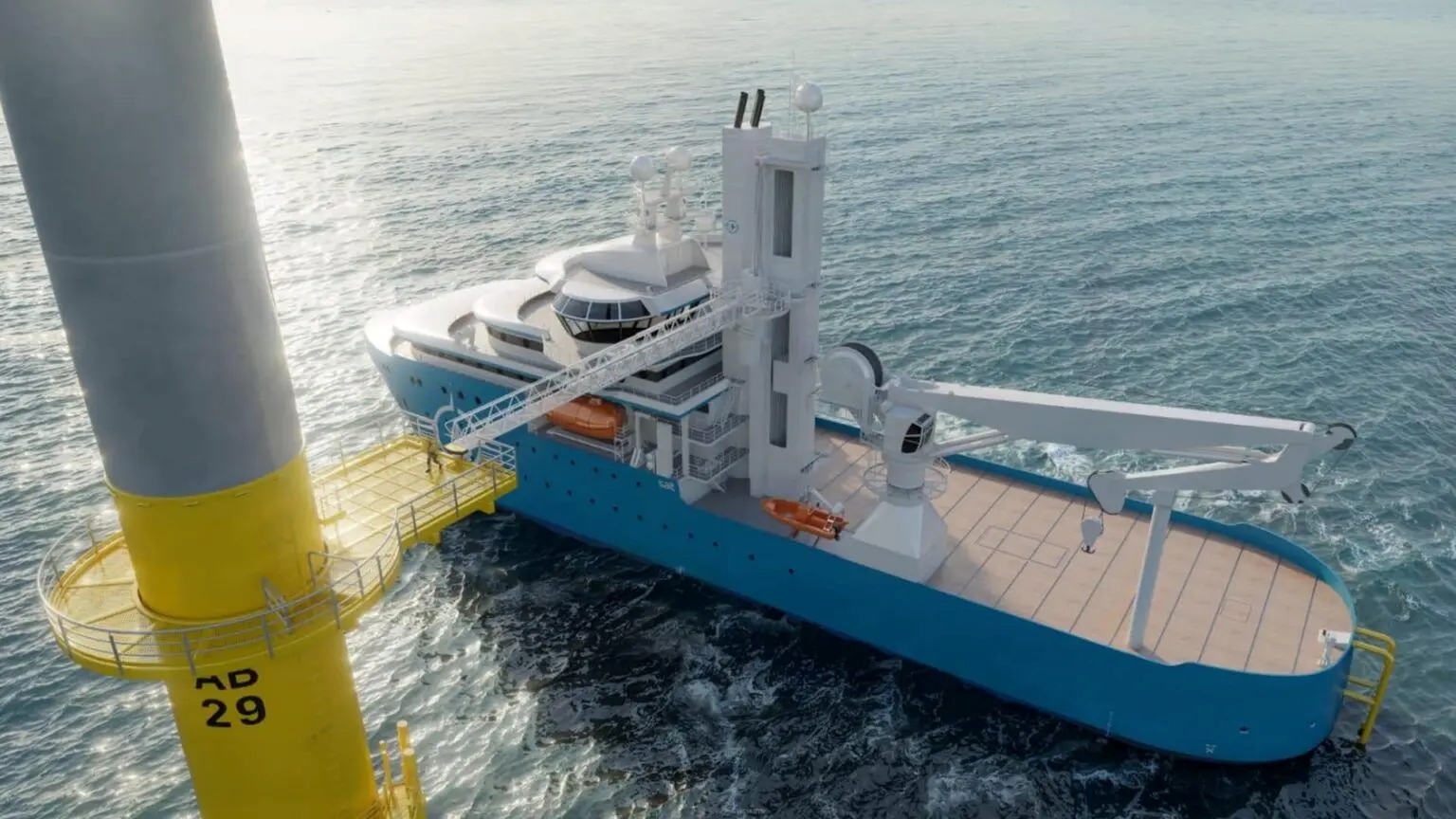
One sector that relies heavily on traditional methods of hydraulics, drives and controls is the offshore industry. With the requirements to keep heavy duty equipment operational without interruption for prolonged periods of time, while in the face of extreme weather conditions and the effects of sea water, the offshore industry presents a unique set of challenges.
One of the main challenges is the requirement to minimise the set-up and configuration time for new offshore installations, whether these are for extraction or for wind power. Given the significant costs associated with maintaining vessels, people and equipment at remote locations for sustained periods of time, reducing installation by as little as a day can result in significant cost savings – so cutting several days or even weeks from the installation schedule provides an excellent way to reduce outlay and optimise project completion times.
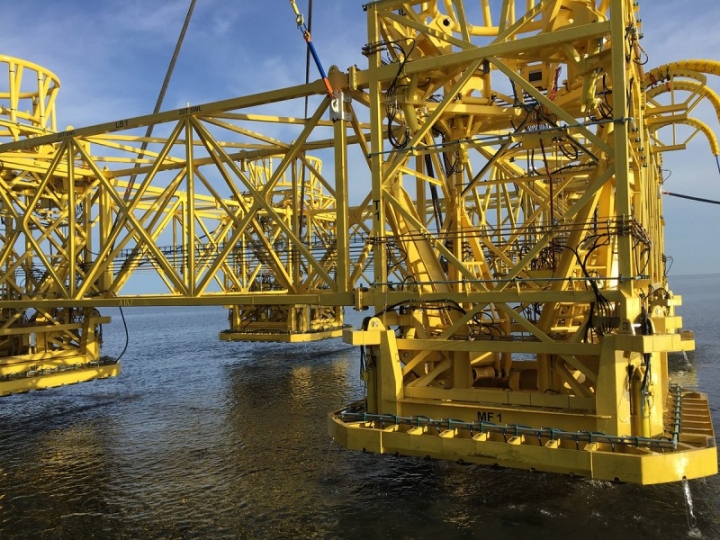
Marine foundation solution company Large Diameter Drilling (LDD), was seeking ways to optimise both the performance and efficiency of their template used for deploying piles at a new offshore wind farm, located 65km off the Baltic coast. Wind farms are becoming increasingly popular as they can generate vast amounts of energy in an environmentally friendly way. Their use offshore has many advantages, one being that wind speeds are typically higher offshore compared with on land, so the contribution in terms of electricity supplied is also higher. LDD specialises in subsea foundation installation services and was keen to improve its current methods of subsea piling – placing piles (the bases on which wind turbines are located) individually – with a faster and more integrated, truly intelligent system.
The project itself involved the deployment of 70 wind turbines in the sea, which had a maximum sea depth of 100 metres. These would be positioned on four subsea piles which needed to be a specific distance apart with minimal margin for error. With each pile weighting up to 175 tonnes, 62 metres in length and a diameter of 2.7 metres, the template used to accurately align the piles was of significant importance. This type of project would be challenging on land, let alone when considering the other factors faced at sea, such as current, pitch, yaw, and gusty winds.
Traditional piling methods position and align each pile sequentially with each subsequent pile location measured from its predecessor. However there are many factors that the process must compensate for. The sea current impacts on the accuracy of pile position in relation to the previous pile or datum. The deformation of the sea bed floor as it compacts during piling affects the installation angle of the pile. Almost invariably, some form of compensation has had to be introduced in the form of shims or the welding of brackets to offset tolerance errors.
Therefore the idea of an ‘intelligent template’ – one that can continuously react to changes in challenging conditions, with a degree of control and automatically correcting the positioning and angle of the pile during installation – was a concept initially thought out by LDD.
With the help of Bosch Rexroth’s innovative thinking, a bespoke hybrid solution was designed and developed which continually monitors and ensures the accurate positioning of the piles through the creation of a reactive template. By doing so, installation could be achieved more rapidly, meaning completion time was reduced.
Rexroth’s role was to draw on its extensive experience to design the hydraulic and control system, verify its effectiveness and suitability, then select the most appropriate materials capable of withstanding the uniquely challenging operating environment.
Such a system was unprecedented and required extensive virtual testing to mitigate both technical and commercial risk, before it could be implemented in a real application. Simulation of response characteristics through finite element analysis (FEA), to ensure these were in line with the customer brief, was essential. Maintaining structural integrity of the piles was key and so gaining a detailed understanding of factors such as spring and deflection under the forces likely to be encountered, was vital. Subjecting the project to a quality gated review process, provided a robust environment for the development of bespoke software. Only when the customer was confident that the control system had been optimised, and all likely eventualities accounted for, could the project proceed to the next stage.
The resulting precision heavy-duty electro-hydraulic control system delivered unprecedented accuracies (±25mm across 676m2) beyond the scope of traditional methods. Unlike traditional techniques, the new active template presented the ability to simultaneously hold the four piles together as a ‘set’, as it optimised the positioning of each pile with a ‘group’ reference including: the seabed, the template and the adjacent pile. This saved a considerable amount of time, and ultimately money, which could typically reach a six-figure sum each day. The final system included fault level detection, with algorithms allowing the generation of error signals which, combined with predictive technology enabled the control system to deliver sequential correction.
The system proved ideal in this application, but perhaps more importantly its capabilities are now being explored for other challenging applications where the accurate positioning of machinery and components is vital for safety and operational reasons.
LDD perfectly illustrates how innovation and trusted techniques are being brought together to achieve benefits that were never thought possible. Forward thinking, flexibility and experience are vital in developing highly competitive systems, helping to improve the efficiency of task completion and ultimately providing a fast, efficient service for the customer. While the technologies themselves may be nothing new, technical vision and an innovative, problem-solving approach are harnessing their capabilities to push the boundaries of industrial performance, minimising risk to the client and end user whilst maintaining competitive advantage.
For more information about Bosch Rexroth, please visit: https://www.boschrexroth.com/en/gb/