Floating Powerhouses: How Pontoons Are Supporting the Offshore Energy Boom
Monday, 9th February 2026
The offshore energy sector is expanding at a remarkable pace. Offshore wind farms are growing in scale, subsea infrastructure is becoming more complex and coastal construction is pushing into environments that demand flexible, reliable support platforms.
Behind much of this progress is a class of floating structures that rarely receive the recognition they deserve: pontoons.
Far from being simple steel boxes, modern pontoons are highly engineered, incredibly adaptable and essential to almost every stage of offshore development. They are the quiet workhorses that make the offshore energy boom possible.
The Engineering Behind Modern Pontoons
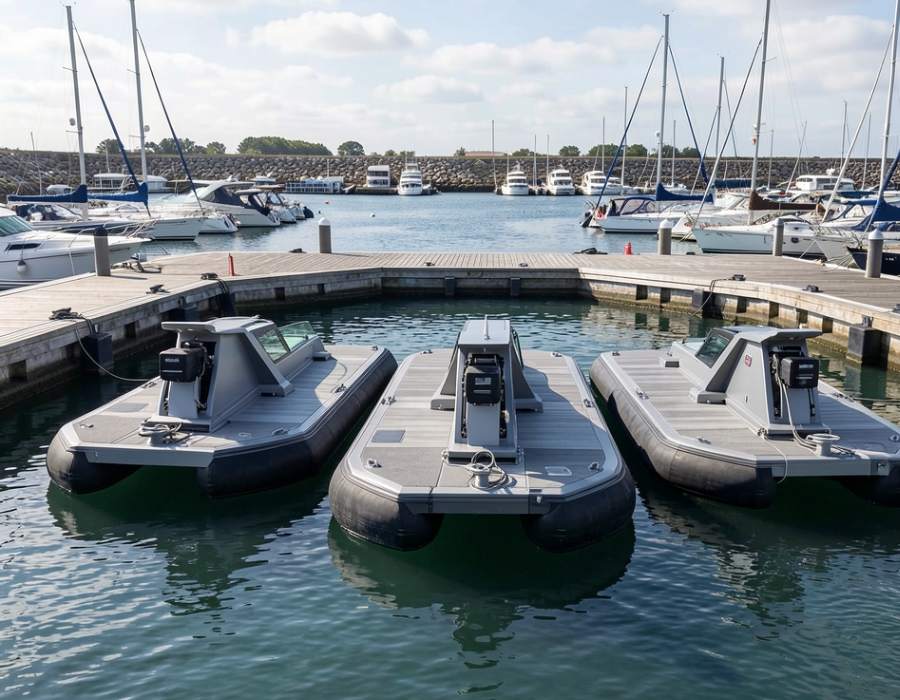
At first glance, a pontoon looks straightforward — a floating platform with a flat deck. But beneath that simplicity lies sophisticated engineering.
Pontoons are typically built from high‑grade marine steel and divided into multiple watertight compartments. This ensures buoyancy and stability even if one section becomes damaged.
Internal bulkheads distribute loads evenly, allowing pontoons to carry enormous weights such as monopiles, transformers, drilling rigs or cable reels. Engineers calculate buoyancy, trim and deck strength with precision to ensure safe operation in waves, wind and tidal currents.
Many pontoons also feature:
- Ballast systems to adjust stability and trim
- Spud legs for temporary seabed anchoring
- Reinforced crane pads for heavy lifting
- Modular connection points allowing multiple pontoons to be joined
This combination of strength, stability and adaptability is what makes pontoons indispensable across offshore industries.
Pontoons in Offshore Wind: Quiet Enablers of a Global Boom
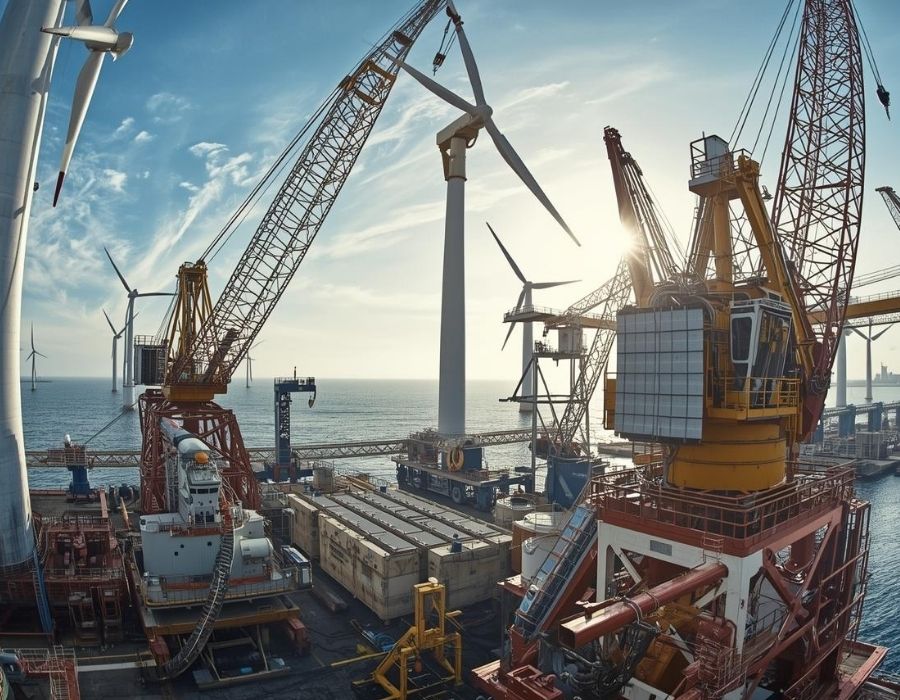
Offshore wind has become one of the biggest drivers of pontoon demand.
As turbines grow taller and components heavier, the need for stable floating platforms has increased dramatically.
Pontoons support offshore wind projects at every stage:
- Early‑stage surveys
Before construction begins, geotechnical teams use pontoons as stable platforms for drilling, sampling and seabed analysis.
- Component transport
Pontoons move oversized items such as transition pieces, cable drums and foundation elements between ports, fabrication yards and installation sites.
- Floating crane operations
In areas where land‑based cranes cannot reach, pontoons fitted with heavy‑lift cranes enable offshore assembly and lifting.
- Cable‑laying support
Cable storage, spooling and deployment equipment can be mounted on pontoons, providing a flexible base for nearshore cable installation.
- Maintenance and repair
Even after a wind farm is operational, pontoons continue to support inspection teams, replacement parts and temporary work platforms.
Without pontoons, many offshore wind projects simply could not be built.
Supporting Oil, Gas and Subsea Infrastructure

While offshore wind is booming, pontoons remain vital in oil and gas operations.
They are used to transport large subsea structures, risers, manifolds and pipeline sections. Their shallow draft allows them to operate in areas where larger vessels cannot manoeuvre.
In subsea construction, pontoons serve as floating bases for:
- ROV operations
- Diving support
- Equipment deployment
- Temporary storage and staging
During decommissioning, pontoons provide stable platforms for cutting equipment, lifting systems and waste containers. Their versatility makes them ideal for dismantling ageing offshore assets safely and efficiently.
Customisation: The Secret to Pontoon Versatility
One of the greatest strengths of modern pontoons is how easily they can be customised.
Every offshore project is different, and pontoons can be adapted to suit almost any requirement.
Customisable features include:
- Deck layouts tailored for cranes, cable reels, drilling rigs or storage
- Accommodation modules for crew and technicians
- Power systems including generators, hybrid units or solar support
- Winches, A‑frames and hydraulic systems for specialist tasks
- Fendering and mooring arrangements for safe operations alongside vessels or structures
- Modular expansion, allowing multiple pontoons to be connected
This adaptability means a single pontoon can serve multiple roles across its lifetime, offering excellent value for operators.
Why Pontoons Are So Valuable to Offshore Operators
Pontoons offer a unique combination of benefits that few other offshore assets can match.
Cost‑effective
Compared to specialised vessels, pontoons are inexpensive to build, operate and maintain.
Highly adaptable
They can be reconfigured for different tasks, making them ideal for multi‑phase projects.
Easy to mobilise
Pontoons can be towed by small tugs, reducing mobilisation costs and allowing access to shallow or restricted areas.
Large working areas
Their open decks provide generous space for equipment, storage and operations.
Stable and safe
With the right ballast and mooring systems, pontoons offer a secure platform for heavy lifting and precision work.
These advantages make them essential across offshore wind, oil and gas, aquaculture, coastal construction and port operations.
The Future of Pontoon Technology
As offshore energy continues to expand, pontoons are evolving to meet new challenges.
Self‑propelled pontoons
These combine the simplicity of a barge with the manoeuvrability of a vessel, reducing reliance on tugs.
Automation and remote monitoring
Sensors and digital systems improve safety, track performance and support predictive maintenance.
Stronger, lighter materials
New steel grades and composite structures are increasing payload capacity without increasing draft.
Low‑emission power systems
Hybrid generators, battery packs and renewable‑assisted systems are becoming more common as operators push for greener operations.
Larger modular platforms
Floating wind, deep‑water infrastructure and large‑scale offshore construction are driving demand for bigger, more capable modular pontoons.
The next generation of pontoons will be smarter, greener and even more versatile.
Conclusion: The Floating Foundations of Offshore Progress
Pontoons may not be glamorous, but they are essential. They are the floating powerhouses that make offshore construction, transport and maintenance possible.
Their engineering is sophisticated, their uses are diverse and their ability to be customised makes them one of the most valuable assets in the marine industry.
As offshore energy continues to grow, pontoons will remain at the heart of the action — supporting the heavy lifting, the precision work and the logistical challenges that define this fast‑moving sector.
They may not always be in the spotlight, but without them, the offshore energy boom simply wouldn’t float.