SubSalve USA Schwer Marine Fittings Hystat Hydraulic Cylinder Manufacturers BP Norse Marine Southbay Marine Services

How to Choose the Right Marine Engineering Partner

Monday, 9th February 2026

Choosing the right marine engineering partner can make or break an offshore or vessel project. Whether you’re commissioning a new workboat, upgrading onboard systems or planning a complex coastal construction operation, the engineering firm you select will shape the project’s safety, performance and long‑term value.

With so many companies offering marine engineering services, it can be difficult to know where to begin. That’s where resources like Seaplant’s Business Finder become invaluable. It brings together trusted marine specialists, allowing you to compare capabilities, experience and expertise in one place.

Here’s how to evaluate marine engineering firms effectively—and how to use directories like Seaplant’s to make confident, informed decisions.

Marine Engineers

  1. Start with Capabilities: Can They Do What You Need?

Every marine engineering project is unique. Before approaching any firm, define your requirements clearly.

Consider:

  • Vessel type or project scope
  • Required engineering disciplines (mechanical, electrical, structural, naval architecture)
  • Expected operating environment
  • Compliance and certification needs
  • Budget and timeline

Once you know what you need, look for firms with proven capability in that specific area. A company that excels in fishing vessel refits may not be the right choice for offshore wind support vessels. Likewise, a general engineering firm may lack the specialist knowledge required for class‑approved modifications.

Seaplant’s directory allows you to filter companies by service type, making it easier to find firms with the right technical strengths.

  1. Check Certifications and Compliance Expertise

Marine engineering is a highly regulated field. The right partner must understand—and be certified to work within—the relevant standards.

Key certifications and approvals may include:

  • Classification society approvals (Lloyd’s Register, DNV, Bureau Veritas, ABS)
  • ISO quality management systems
  • Welding and fabrication certifications
  • Electrical and safety compliance qualifications
  • Environmental and sustainability standards

A reputable engineering firm will be transparent about its certifications and happy to provide documentation. If a company is vague or evasive, treat it as a red flag.
Marine Engineering Asia

  1. Review Previous Builds and Case Studies

Past performance is one of the strongest indicators of future reliability.

Look for:

  • Completed vessel builds
  • Major refits or conversions
  • Offshore engineering projects
  • Specialist installations (hybrid propulsion, DP systems, deck machinery, etc.)
  • Client testimonials

A strong engineering partner will showcase its work proudly. Case studies reveal not only technical capability but also how the company handles challenges, deadlines and communication.

Seaplant’s Business Finder often links directly to company websites, making it easy to explore portfolios and past projects.

  1. Assess Technical Depth and In‑House Expertise

Marine engineering is rarely a one‑discipline job. The best firms offer integrated expertise across multiple areas.

Ask about:

  • In‑house design teams
  • Naval architects and structural engineers
  • Electrical and automation specialists
  • Fabrication and machining facilities
  • Project management capability

A company with a broad in‑house team can deliver smoother workflows, fewer delays and better quality control. Outsourcing isn’t necessarily a problem, but it should be managed transparently.

  1. Evaluate Their Approach to Innovation

The marine industry is evolving rapidly. Hybrid propulsion, digital monitoring, lightweight materials and advanced safety systems are becoming standard.

A forward‑thinking engineering partner should be:

  • Familiar with modern propulsion technologies
  • Comfortable integrating digital systems
  • Experienced with energy‑efficient solutions
  • Up‑to‑date with emerging regulations
  • Willing to propose improvements, not just follow instructions

Innovation doesn’t mean unnecessary complexity—it means smarter, safer and more efficient solutions.

  1. Consider Their Understanding of Your Sector
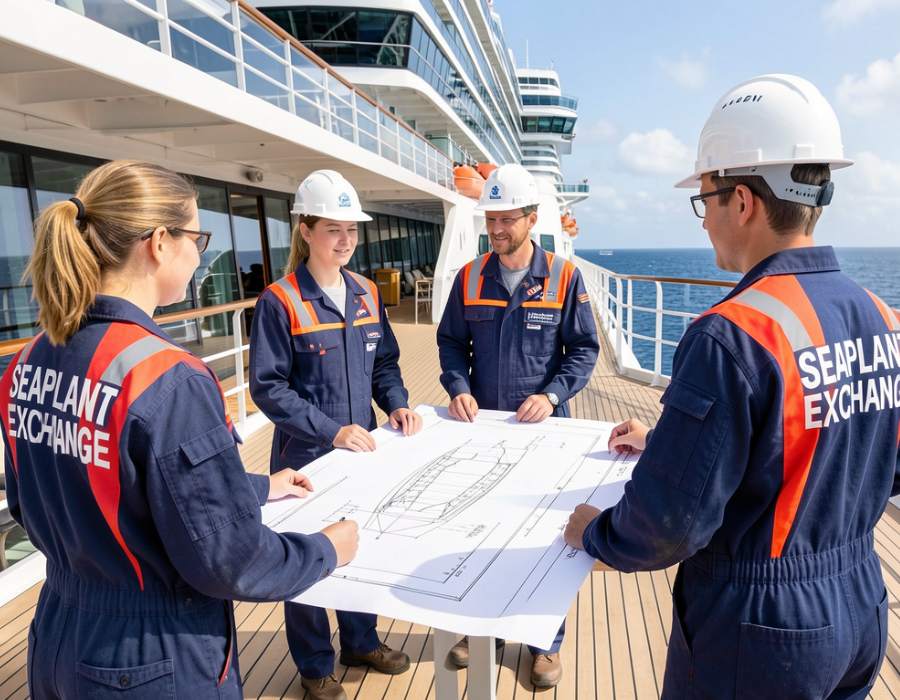
Marine Engineers

Marine engineering is broad. A firm that specialises in aquaculture vessels may not be the best fit for offshore wind. A company focused on port infrastructure may not understand the demands of high‑speed crew transfer vessels.

Look for sector‑specific experience in areas such as:

  • Offshore wind
  • Oil and gas
  • Workboats and utility craft
  • Survey and research vessels
  • Tugs and towage
  • Dredging and coastal construction
  • Passenger ferries

Sector familiarity means fewer misunderstandings, better design decisions and a smoother project overall.

  1. Check Their Facilities and Build Capacity

A firm’s physical capabilities matter just as much as its technical expertise.

Important factors include:

  • Workshop size and equipment
  • Lifting and cranage capacity
  • Dry‑dock or slipway access
  • Welding and fabrication facilities
  • Storage and logistics capability

A company with limited facilities may struggle with large or complex projects, leading to delays or quality issues.

  1. Look for Strong Communication and Project Management

Engineering excellence is only half the story. The best marine engineering partners communicate clearly, plan effectively and keep clients informed.

Signs of strong project management include:

  • Clear timelines and milestones
  • Transparent pricing
  • Regular progress updates
  • Dedicated project managers
  • Documented quality‑control processes

Good communication builds trust and ensures the project stays on track.

  1. Compare Quotes—But Don’t Choose on Price Alone

Marine engineering is a specialist field, and quality comes at a cost. While it’s important to stay within budget, the cheapest option is rarely the best.

When comparing quotes, consider:

  • Scope of work
  • Materials and equipment quality
  • Warranty terms
  • After‑sales support
  • Delivery timescales

A slightly higher upfront cost can save significant money over the vessel’s lifetime.

  1. Use Seaplant’s Directory to Shortlist Trusted Partners

The Seaplant Business Finder  is a valuable tool for identifying reputable marine engineering firms.

It allows you to:

  • Search by service type
  • Filter by location
  • Explore company profiles
  • Access contact details
  • Compare multiple providers quickly

Instead of searching blindly, you can build a shortlist of trusted, established companies with proven marine expertise.

Conclusion: Choose a Partner Who Understands Your Vision

Selecting the right marine engineering partner is one of the most important decisions you’ll make in any offshore or vessel project. The right firm will bring technical excellence, sector knowledge and a collaborative approach that supports your goals from concept to completion.

By evaluating capabilities, certifications, past work and communication style—and by using trusted directories like Seaplant’s—you can choose a partner who delivers quality, reliability and long‑term value.

A great engineering partner doesn’t just build or repair vessels. They help you operate safely, efficiently and confidently in one of the world’s most demanding environments.


Liferafts International DiveCo Marine Civils Sealane Maritime Engineering
SubSalve USA Schwer Marine Fittings Hystat Hydraulic Cylinder Manufacturers BP Norse Marine Southbay Marine Services

Floating Powerhouses: How Pontoons Are Supporting the Offshore Energy Boom

Monday, 9th February 2026

The offshore energy sector is expanding at a remarkable pace. Offshore wind farms are growing in scale, subsea infrastructure is becoming more complex and coastal construction is pushing into environments that demand flexible, reliable support platforms.

Behind much of this progress is a class of floating structures that rarely receive the recognition they deserve: pontoons.

Far from being simple steel boxes, modern pontoons are highly engineered, incredibly adaptable and essential to almost every stage of offshore development. They are the quiet workhorses that make the offshore energy boom possible.

The Engineering Behind Modern Pontoons

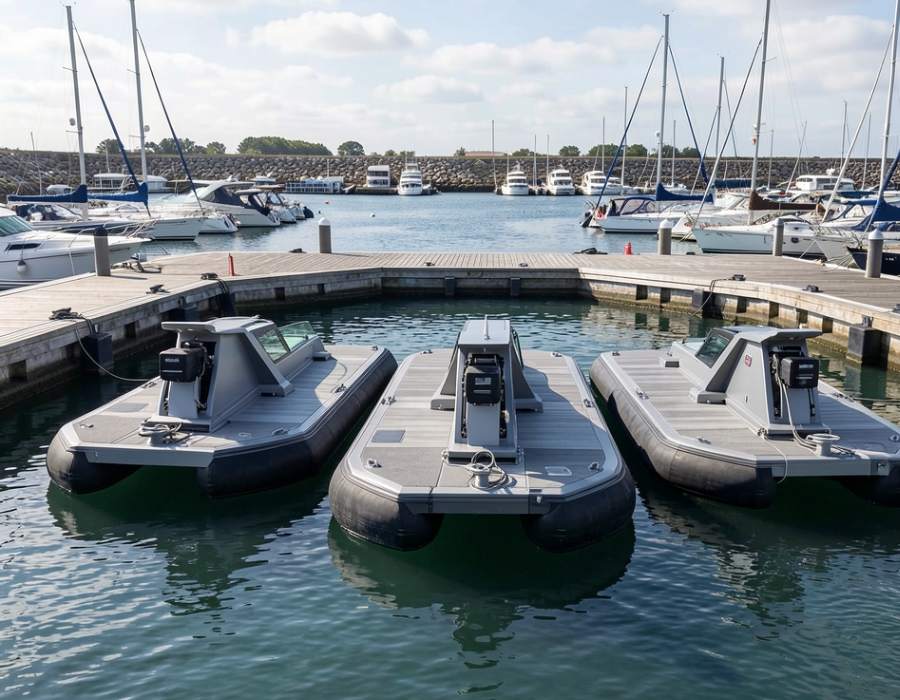
Marina Ballast Pontoons

At first glance, a pontoon looks straightforward — a floating platform with a flat deck. But beneath that simplicity lies sophisticated engineering.

Pontoons are typically built from high‑grade marine steel and divided into multiple watertight compartments. This ensures buoyancy and stability even if one section becomes damaged.

Internal bulkheads distribute loads evenly, allowing pontoons to carry enormous weights such as monopiles, transformers, drilling rigs or cable reels. Engineers calculate buoyancy, trim and deck strength with precision to ensure safe operation in waves, wind and tidal currents.

Many pontoons also feature:

  • Ballast systems to adjust stability and trim
  • Spud legs for temporary seabed anchoring
  • Reinforced crane pads for heavy lifting
  • Modular connection points allowing multiple pontoons to be joined

This combination of strength, stability and adaptability is what makes pontoons indispensable across offshore industries.

Pontoons in Offshore Wind: Quiet Enablers of a Global Boom

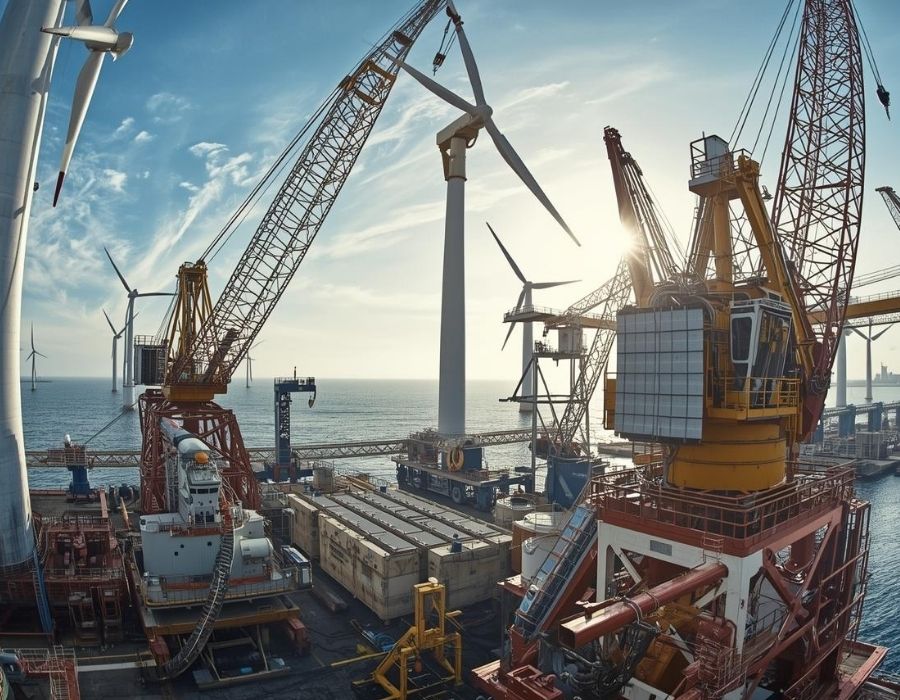
Wind Farm Heavy Lifting

Offshore wind has become one of the biggest drivers of pontoon demand.

As turbines grow taller and components heavier, the need for stable floating platforms has increased dramatically.

Pontoons support offshore wind projects at every stage:

  1. Early‑stage surveys

Before construction begins, geotechnical teams use pontoons as stable platforms for drilling, sampling and seabed analysis.

  1. Component transport

Pontoons move oversized items such as transition pieces, cable drums and foundation elements between ports, fabrication yards and installation sites.

  1. Floating crane operations

In areas where land‑based cranes cannot reach, pontoons fitted with heavy‑lift cranes enable offshore assembly and lifting.

  1. Cable‑laying support

Cable storage, spooling and deployment equipment can be mounted on pontoons, providing a flexible base for nearshore cable installation.

  1. Maintenance and repair

Even after a wind farm is operational, pontoons continue to support inspection teams, replacement parts and temporary work platforms.

Without pontoons, many offshore wind projects simply could not be built.

Supporting Oil, Gas and Subsea Infrastructure

Modular Pontoons

While offshore wind is booming, pontoons remain vital in oil and gas operations.

They are used to transport large subsea structures, risers, manifolds and pipeline sections. Their shallow draft allows them to operate in areas where larger vessels cannot manoeuvre.

In subsea construction, pontoons serve as floating bases for:

  • ROV operations
  • Diving support
  • Equipment deployment
  • Temporary storage and staging

During decommissioning, pontoons provide stable platforms for cutting equipment, lifting systems and waste containers. Their versatility makes them ideal for dismantling ageing offshore assets safely and efficiently.

Customisation: The Secret to Pontoon Versatility

One of the greatest strengths of modern pontoons is how easily they can be customised.

Every offshore project is different, and pontoons can be adapted to suit almost any requirement.

Customisable features include:

  • Deck layouts tailored for cranes, cable reels, drilling rigs or storage
  • Accommodation modules for crew and technicians
  • Power systems including generators, hybrid units or solar support
  • Winches, A‑frames and hydraulic systems for specialist tasks
  • Fendering and mooring arrangements for safe operations alongside vessels or structures
  • Modular expansion, allowing multiple pontoons to be connected

This adaptability means a single pontoon can serve multiple roles across its lifetime, offering excellent value for operators.

Why Pontoons Are So Valuable to Offshore Operators

Pontoons offer a unique combination of benefits that few other offshore assets can match.

Cost‑effective

Compared to specialised vessels, pontoons are inexpensive to build, operate and maintain.

Highly adaptable

They can be reconfigured for different tasks, making them ideal for multi‑phase projects.

Easy to mobilise

Pontoons can be towed by small tugs, reducing mobilisation costs and allowing access to shallow or restricted areas.

Large working areas

Their open decks provide generous space for equipment, storage and operations.

Stable and safe

With the right ballast and mooring systems, pontoons offer a secure platform for heavy lifting and precision work.

These advantages make them essential across offshore wind, oil and gas, aquaculture, coastal construction and port operations.

The Future of Pontoon Technology

As offshore energy continues to expand, pontoons are evolving to meet new challenges.

Self‑propelled pontoons

These combine the simplicity of a barge with the manoeuvrability of a vessel, reducing reliance on tugs.

Automation and remote monitoring

Sensors and digital systems improve safety, track performance and support predictive maintenance.

Stronger, lighter materials

New steel grades and composite structures are increasing payload capacity without increasing draft.

Low‑emission power systems

Hybrid generators, battery packs and renewable‑assisted systems are becoming more common as operators push for greener operations.

Larger modular platforms

Floating wind, deep‑water infrastructure and large‑scale offshore construction are driving demand for bigger, more capable modular pontoons.

The next generation of pontoons will be smarter, greener and even more versatile.

Conclusion: The Floating Foundations of Offshore Progress

Pontoons may not be glamorous, but they are essential. They are the floating powerhouses that make offshore construction, transport and maintenance possible.

Their engineering is sophisticated, their uses are diverse and their ability to be customised makes them one of the most valuable assets in the marine industry.

As offshore energy continues to grow, pontoons will remain at the heart of the action — supporting the heavy lifting, the precision work and the logistical challenges that define this fast‑moving sector.

They may not always be in the spotlight, but without them, the offshore energy boom simply wouldn’t float.


Liferafts International DiveCo Marine Civils Sealane Maritime Engineering
SubSalve USA Schwer Marine Fittings Hystat Hydraulic Cylinder Manufacturers BP Norse Marine Southbay Marine Services

Tyne Dock Enterprise Quay Wall Nears Completion

Wednesday, 5th November 2025

Southbay Civil Engineering Nears Completion of Tyne Dock Enterprise Quay Wall Phase 2

Southbay Civil Engineering is proud to announce that construction is entering its final stages on the Tyne Dock Enterprise Quay Wall Phase 2 project — a significant addition to the region’s growing portfolio of high-quality marine and port infrastructure.

The project involved the design and construction of a 90-metre quay wall, complete with full anchorage, successfully delivered within a live operational environment.

All piling operations have now been completed, including the installation of a combi wall system comprising 29 tubular steel piles, each measuring 1,422mm in diameter and 20m in length. The new quay has been designed to provide a bearing capacity of 10 tonnes per square metre, supporting future growth in the renewable energy sector and wider port operations.

In addition to the quay wall, the project includes comprehensive berthing facilities such as fendering, bollards, and quayside ladders — ensuring long-term functionality, safety, and durability.

To date, the project team has successfully achieved over 50,000 work hours without a single accident or environmental incident, reflecting Southbay’s ongoing commitment to health, safety, and environmental excellence.

Beyond marine construction delivery, Southbay has continued to invest in the local community, contributing to social value initiatives throughout the project. This has included hosting an educational presentation and site visit for Benfield High School students, as well as providing a work placement opportunity for a Newcastle University student, helping to inspire and support the next generation of civil engineers.

Associated Listing:
Liferafts International DiveCo Marine Civils Sealane Maritime Engineering
SubSalve USA Schwer Marine Fittings Hystat Hydraulic Cylinder Manufacturers BP Norse Marine Southbay Marine Services

Offshore Energy Industry urged to prioritise safety in the era of AI

Wednesday, 3rd September 2025

DNV research to reveal gap between AI and offshore safety at SPE Offshore Europe 2025

As part of the SPE Offshore Europe 2025 (OE25) technical programme, DNV, the independent energy expert and assurance provider, will spotlight its latest research into the emerging risks of artificial intelligence (AI) in the offshore sector.

With concerns such as cyberattacks or AI-driven equipment failures already on the radar of offshore operators, the paper demonstrates that less detectable risks, those emerging from unpredictable interactions between humans and AI, pose the greatest threat to operational safety.

AI is emerging as a useful tool

AI is emerging as a useful tool in many industries, often in a bottom-up way as individuals use AI-based tools in their daily work. At the same time, AI technology itself is evolving at high speed, with new capabilities and potential applications constantly arising.

Graham Faiz, Head of Digital Energy at DNV, said: “Ensuring safety in the face of a disruptive new technology is paramount, particularly in the offshore environment. AI will certainly find applications within the sector; however, its emergence presents a real challenge to regulators due to its disruptive nature, extremely rapid pace of development and easy accessibility to individuals. For example, suppose an individual engineer uses a generative AI engine to write standard operating procedures for a new piece of equipment. How does the marine industry ensure that maximum safety is maintained? This is just one example of how AI-related risks could potentially overwhelm traditional safety mechanisms.”

To address this growing challenge, DNV’s research proposes a systemic safety framework that incorporates safety engineering principles and AI assurance across the entire system lifecycle.

AI will be tested in offshore settings to understand and manage safety risks. Specific scenarios, known as ‘use cases,’ will be studied to identify risks and suggest ways to mitigate them, focusing on how AI evolves over time, the complexity of its decisions, and its impact on both individuals and the broader system. This approach forms the basis of the safety framework.

Hari Vamadevan, Senior Vice President and Regional Director UK and Ireland, Energy Systems at DNV, said: “Offshore Europe brings together organisations and industry leaders from across the global energy sector, making it the ideal platform to showcase innovation and contribute to critical industry conversations. AI is becoming increasingly ingrained in the industry, and as humans and AI become more integrated, their interactions become more unpredictable. However, we have seen little consideration of how existing safety systems can address this new technology. A new approach is needed to directly address the emergent risks of AI integration across our industry.

“As the UK continues to build out its renewable energy infrastructure, we see a strong opportunity to develop and embed robust safety frameworks, which include the use of AI, from the very beginning. By identifying and mitigating potential risks, our work aims to prevent unintended consequences and ensure the safe integration of AI in safety-critical operations.”

Research presented at Offshore Europe 25

The research will be presented at OE25, taking place 2-5 September at P&J Live, Aberdeen. A record 600 abstracts were submitted for the technical programme which will feature 18 sessions and more than 70 papers within oil and gas, net zero and digital streams.

DNV will present its technical paper and findings as part of the Digital: AI Supported Subsurface technical session on Wednesday, 3 September at 2:30pm in Meeting Room 7. With the offshore industry pushing forward on digital transformation and net-zero goals, DNV’s findings are expected to play a key role in shaping safety standards and AI governance across the sector.

This year’s paper is a continuation of DNV’s research that was presented at OE23, which found that although AI is being readily used across the sector, there was a lack of trust in the technology. Two years on, the conversation has shifted to how the industry can address the challenges that AI will introduce. A 2025 DNV survey found that, of 1160 companies across Europe, North America, Central and South America, and Asia, 60% of respondents stated that they will use AI-driven applications in their operations in the year ahead: up from 47% in 2024.

Associated Exhibition:
Liferafts International DiveCo Marine Civils Sealane Maritime Engineering
SubSalve USA Schwer Marine Fittings Hystat Hydraulic Cylinder Manufacturers BP Norse Marine Southbay Marine Services

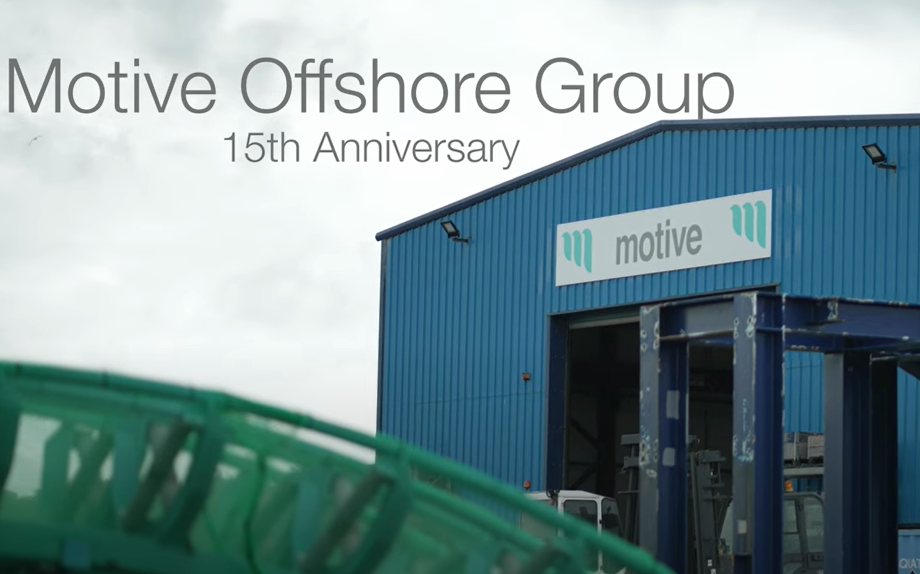
Motive celebrates 15 Year Anniversary

Monday, 4th August 2025

As Motive celebrates this 15-year milestone, we look back with pride at how far we’ve come – through challenging times, transformative growth, and unwavering commitment.

Motive’s journey began with a simple conversation between two colleagues who saw an opportunity to build something better. It’s a story of resilience through challenging industry times where, rather than give up, the founders made difficult personal and professional decisions to ensure a future for the company.

A period of adversity became a defining moment, driving Motive’s transformation from a specialised rental business into a full-service back-deck and cable lay solutions provider. This strategic evolution, coupled with diversification from traditional oil and gas into the emerging renewables market, cemented the company’s global footprint. With a values-driven team and a clear vision, Motive emerged stronger, more resilient, and better positioned for the future.

In our video celebrating Motive’s 15 Year milestone you can hear about those moments that defined us – the highs, the lows, and everything in between. This isn’t just a reflection on our past, it’s an unfiltered look at who Motive are, and at the future we’re continuing to build together.

The company’s success is a testament to its people-first approach. Motive extends its deepest gratitude to every employee, partner, and client who has been part of this incredible journey.

Team Motive is more energised than ever to tackle new challenges and achieve even greater things. The next chapter of the Motive story is just beginning.


Associated Listing:
Liferafts International DiveCo Marine Civils Sealane Maritime Engineering
SubSalve USA Schwer Marine Fittings Hystat Hydraulic Cylinder Manufacturers BP Norse Marine Southbay Marine Services

NR Marine Services and WMD Announce New Cyclone Class CTV

Wednesday, 11th June 2025

Following on from the success of the recent CTV’s, we are delighted to announce that NR Marine Services have engaged WMD to develop the new Cyclone Class CTV.

Building on the proven capabilities of the Storm & Typhoon Class CTV’s, the Cyclone Class will enhance onboard accommodation and welfare facilities, offering a new level of comfort and functionality for offshore operations.

NR Marine’s Storm & Typhoon Class vessels have been designed by WMD and built at Isle of Wight shipyard, Diverse Marine. The Cyclone Class continues NR Marine’s commitment to supporting both UK vessel design and shipbuilding. With an extended 29-metre hull, the Cyclone Class allows for increased internal volume, accommodating up to 6 cabins and 24 passengers.

Key design features include:

– Length: 29 metres

– Deck cargo capacity: 30 tonnes

– Propulsion: 4 x Volvo IPS1050

– Maximum speed: 28 knots

Owen Nutt, Director at NR Marine says “Working with WMD on the new Cyclone range was a no-brainer. Their previous designs have exceeded expectations, and we’re excited to welcome this new vessel into our fleet.”

Nikki Walker, Project Manager at WMD comments “We’ve really enjoyed seeing NR Marine grow since the delivery of their first WMD-designed vessel. Being trusted to help them develop a new class of vessel is a huge compliment, and we look forward to seeing the Cyclone Class take shape and enter operation.”

WMD will be exhibiting at Seawork on Stand G19 from 10–12 June 2025 in Southampton. NR Marine will be showcasing their new vessel, NR HUNTER, at Berth VB22 alongside Diverse Marine.

Associated Listing:
Liferafts International DiveCo Marine Civils Sealane Maritime Engineering
SubSalve USA Schwer Marine Fittings Hystat Hydraulic Cylinder Manufacturers BP Norse Marine Southbay Marine Services

Do business with defence at Ocean Business 2025

Monday, 24th March 2025

Defence and security will be a key focus of Ocean Business 2025, the global technology and science exhibition for marine industries.

More than 350 world-leading manufacturers and service providers shaping the future of ocean science and technology have booked space at the sold-out show, many with a track record specialising in defence products and services.

The three-day event, which runs from April 8-10 at the National Oceanography Centre in Southampton, is free to all visitors who register online at www.oceanbusiness.com.

The Minister for Maritime, Aviation, and Security, Mike Kane, will address showgoers in a talk delivered via video.

The Ocean Business conference, starting on Tuesday, April 8, will explore the Royal Navy’s autonomous systems for data collection.

Keynote speakers Commander Mark Butcher of Navy Develop and Andy Liddell of Defence Equipment and Support will provide insights into the Future Military Data Gathering (FMDG) programme. They will discuss the challenges in certifying autonomous systems, standardising data, and leveraging machine learning for real-time analysis to optimise maritime operations.

On day two of the conference, Claire Budden, Deputy Director of Navy Commercial, kicks off the Doing Business with Defence session, chaired by Sharon Jones, Regional Lead of the Navy’s Maritime Enterprise Engagement.

Against the backdrop of the Strategic Defence Review, the Procurement Act and fast-changing geopolitics, speakers will highlight how collaboration in innovation supports national security. Technology is creating both threats to and opportunities for the UK’s security and prosperity, and staying ahead is vital to maintaining our military advantage.

With talks from DASA (Defence and Security Accelerator), Crown Commercial, a Royal Navy presentation team, and commercial experts in the field, including Ploughshare’s Ned Vardey, the session will investigate how current international activity is changing the procurement pipeline; how the MoD supports science and technology transfer and exploitation; how non-traditional suppliers can enter the defence supply base; and where commercial technologies and services can be applied in defence.

The Society for Underwater Technology, which hosted a Routes for Innovation in the Defence Market session at Ocean Business 2023, said: ‘It was inspiring to see such a diverse group of professionals coming together to explore and discuss the latest trends and opportunities in the subsea defence industry.’

Also, on Wednesday, April 9, a Women in Marine Networking Lunch will offer delegates a chance to hear Claire Budden’s thoughts on Empowering Women in maritime leadership through innovation and new ways of working.

Ocean Business 2025 features a training programme and demonstrations on the dockside, onboard vessels and in the classroom, alongside its main exhibition halls.

Visitors will be able to see the latest developments in transformational ocean technology, including autonomous vehicle underwater monitoring, next-generation ROVs, ground-breaking advances in sensor technology, and much more.

This year, around 30 exhibitors have a specific defence remit, from UK companies, including Saab Seaeye, ecoSUB Robotics, and Wavefront Systems to trusted partners from Canada, France, Denmark, Germany, Australia, and the US.

Cheri Arvonio, Event Director at show organiser Diversified Communications, said: ‘Ocean Business 2025 will bring together ocean technology trailblazers from across the world for three days of exciting product launches, innovation and ideas across a range of sectors, not least, defence and security.

‘We look forward to welcoming both Ocean Business regulars and first-time showgoers to what promises to be a bumper exhibition, with unbeatable opportunities for doing new business, sealing deals, networking, and hearing industry updates.’

Associated Exhibition:
Liferafts International DiveCo Marine Civils Sealane Maritime Engineering
SubSalve USA Schwer Marine Fittings Hystat Hydraulic Cylinder Manufacturers BP Norse Marine Southbay Marine Services

Engine failures build up over time

Friday, 14th March 2025

Marine Diesel Engine failures don’t happen overnight—they build up over time

Bartech Marine Engineering Case Study

A marine operator’s Caterpillar marine diesel engine failed, and Bartech were called to assist. During the inspection, there was increasing fuel oil contamination in the sump, vibration issues, blue smoke, and reduced power output. Further investigation revealed that cylinder 12 had a partially missing valve, allowing unburned fuel to flood the sump. There was also water ingression in both cylinder banks—an issue that could have been prevented with regular checks.

The True Cost of Neglected Maintenance

Turbocharger Damage – Both turbine wheel assemblies were compromised, reducing engine boost pressure and overall power.
Corrosion & Water Contamination – Found in the air cooler air box, accelerating wear and reducing efficiency.
Cylinder & Piston Damage – A missing inlet valve caused severe damage to the piston crown, while debris from the failure affected another cylinder.
Camshaft Wear – Scoring was found on one of the journals, indicating progressive deterioration.
Damage found on Caterpillar engine

Instead of a quick overhaul, this vessel required major rectification work, which could have been avoided with routine servicing. Fortunately a suitable replacement marine diesel engine was found to get them back up and running with minimal downtime. The original engine will now undergo a full engine overhaul to ensure it’s available when needed, preventing future disruptions.

Why Preventative Maintenance Matters

Avoid Expensive Failures – Small issues, if caught early, prevent catastrophic breakdowns or more expensive engine repairs.
Minimise Downtime – Routine servicing keeps vessels operational when it matters most.
Extend Engine Life – Regular inspections protect your investment and performance.
Ensure Reliability – Reduce the risk of unexpected failures at sea.
Preventative maintenance isn’t just an expense—it’s an investment in reliability, efficiency, and cost savings.

To see how Bartech Marine can help keep your diesel engines running at their best visit our website at www.bartechmarine.com

Associated Listing:
Liferafts International DiveCo Marine Civils Sealane Maritime Engineering
SubSalve USA Schwer Marine Fittings Hystat Hydraulic Cylinder Manufacturers BP Norse Marine Southbay Marine Services

Bronze Pumps For Vessels & Workboats

Thursday, 6th February 2025

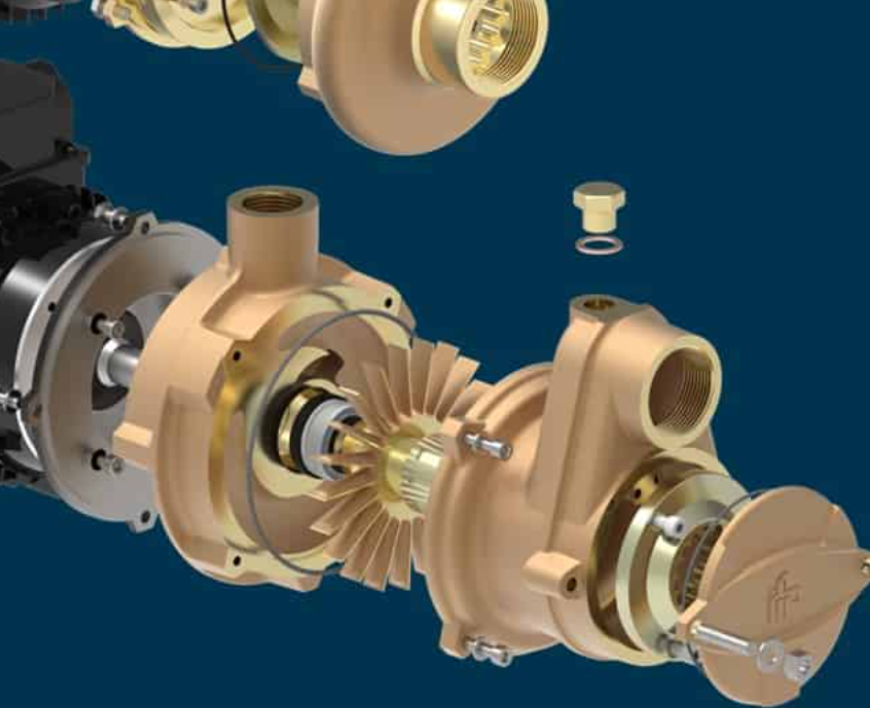
Charles Cleghorn Ltd offers a comprehensive selection of Forani Pumps, readily available for fishing vessels and workboats.

Their pumps are perfect for bilge and deck wash applications, engine and general equipment cooling, and fire line duties. You can choose to acquire units with bare shafts or equipped with close-coupled motors.

Limerick  ” Skipper ” Show 21st and 22nd March

We will showcase a large selection of pumps. Laurence Bellamy of Lancing Marine will be with us, promoting his Castoldi Water Jets & marine propulsion equipment including FPT engines & gearboxes.

Forani Bronze Marine Pumps for Vessels – Available at Charles Cleghorn Ltd

Forani bronze marine pumps, offered by Charles Cleghorn Ltd, are renowned for their durability and reliability in demanding marine environments. These high-quality pumps are designed specifically for the marine sector, providing excellent performance in seawater applications. Constructed from marine-grade bronze, they offer superior resistance to corrosion, ensuring long-lasting service life even in the harshest saltwater conditions.

The Forani range includes centrifugal and turbine pumps, ideal for cooling systems, bilge operations, and other critical onboard applications. These pumps are known for their efficiency, ease of maintenance, and robust design, making them a preferred choice for commercial vessels, workboats, and fishing fleets.

With decades of experience, Charles Cleghorn Ltd provides expert advice and support to ensure customers receive the right Forani pump for their specific requirements. Forani and Charles Cleghorn Ltd are trusted names in the industry for reliable marine pumping solutions.

Associated Listing:
Associated Exhibition:
Liferafts International DiveCo Marine Civils Sealane Maritime Engineering
SubSalve USA Schwer Marine Fittings Hystat Hydraulic Cylinder Manufacturers BP Norse Marine Southbay Marine Services

Ecocoast tackles pollution with solar-powered innovation

Tuesday, 21st January 2025

Ecocoast and Noria unite to tackle pollution with solar-powered innovation

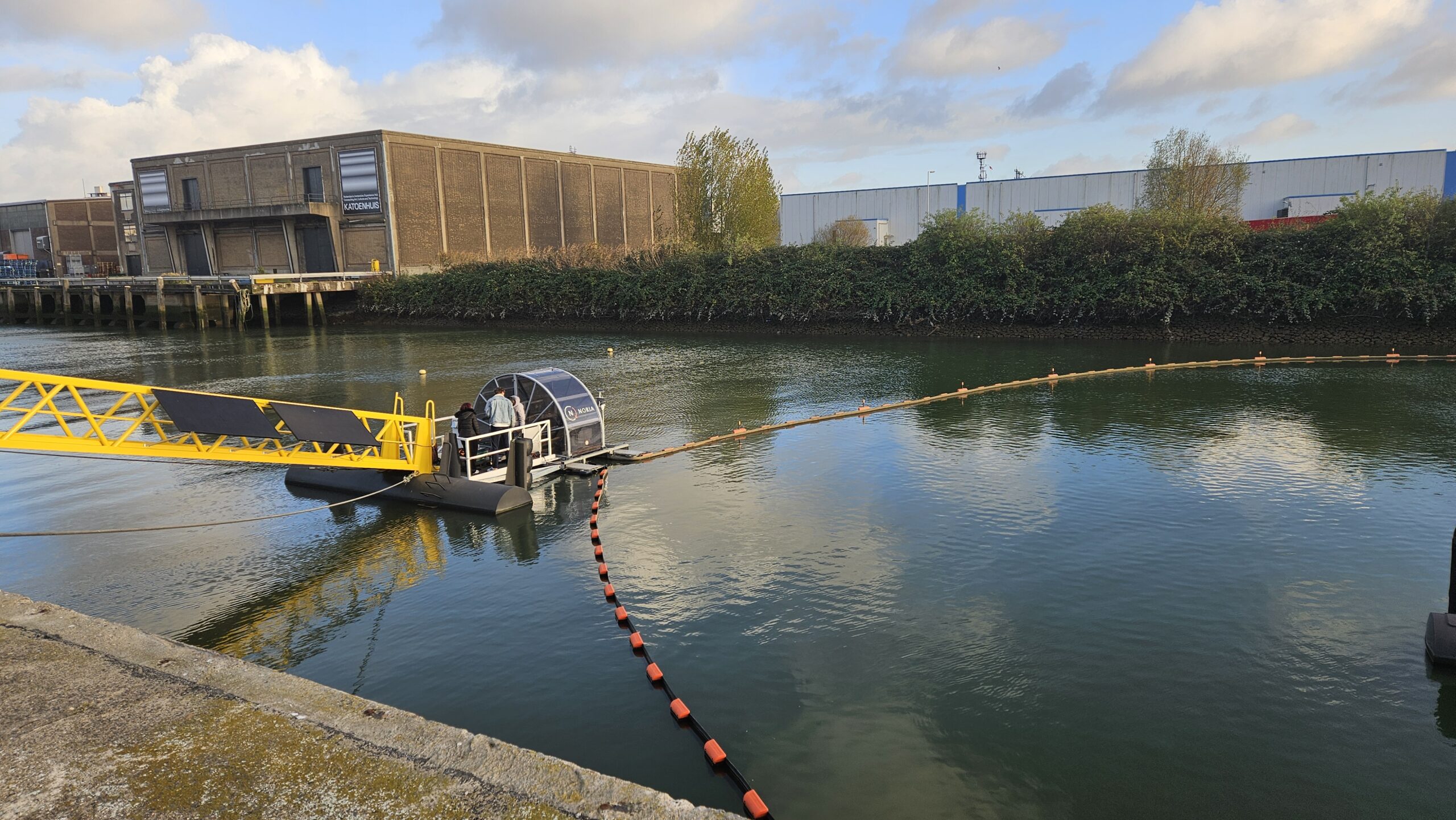
In a groundbreaking collaboration, Ecocoast, a global leader in marine and coastal protection, has joined forces with Noria to revolutionize the fight against waterway pollution. The partnership combines Ecocoast’s durable Bolina Permanent Debris Booms with Noria’s innovative CirCleaner system, currently operational at Rotterdam’s Keilehaven in the Netherlands. Together, they are setting a new benchmark for cleaning rivers and canals sustainably.

The CirCleaner System

The CirCleaner system is designed to prevent plastic pollution and debris from harming marine ecosystems while improving the quality of local waterways. Ecocoast’s custom debris booms, manufactured in Noria’s signature orange, funnel an impressive 3 cubic meters of waste weekly into the CirCleaner, diverting it from reaching the sea and reducing pollution. Spanning 48 meters on one side and 34 meters on the other, the boom arms guide waste directly into the system, ensuring maximum efficiency.

The CirCleaner system operates on solar power and adjusts its collection cycles to the natural tidal flow, maximizing operational efficiency. In addition to removing waste, the system incorporates fish-friendly technology, ensuring the protection of aquatic life while removing waste. Its solar-powered functionality and adaptability underscore its commitment to sustainability and responsible resource use.

Growing Urgency to Protect Europe’s Waterways

This partnership emphasizes the growing urgency to protect Europe’s waterways. James West, Regional Business Development Manager at Ecocoast, highlighted the importance of this initiative, stating:

“At Ecocoast, we are dedicated to building safer, cleaner and more sustainable coastlines and waterways. The integration of our PDB400 Bolina Permanent Debris Booms with Noria’s CirCleaner system demonstrates the effectiveness of joint efforts in combating plastic pollution. We are proud to work with Noria on this project.”

He continued, “This effort builds on our extensive experience in partnering on impactful projects to protect marine environments across Europe and beyond. One notable example is our work with DEME, which resulted in the installation of Europe’s longest debris boom in Belgium.”

Noria’s focus on sustainability extends beyond the technology itself. During the installation process, the team took extra care to clean up rubber shavings to prevent microplastic contamination – a small but powerful act of environmental stewardship.

Inspiring Model for Waterway Protection

This project serves as an inspiring model of how local and international partnerships can achieve real change. As pollution remains a pressing issue in waterways from the Thames to Rotterdam, solutions like this offer hope for a cleaner future.

This installation at Keilehaven marks a significant milestone in the ongoing fight against water pollution. It is part of a broader effort by Ecocoast to contribute to cleaner and healthier waterways across Europe and beyond. With a steadfast commitment to sustainability and innovation, Ecocoast is setting a new standard in waterway protection, empowering organizations like Noria to improve the health of our ecosystems and reduce the impact of pollution on local communities.

For more information about Ecocoast.

For more information on the CirCleaner, please visit https://www.noria.earth/circleaner/.

Associated Listing:
Liferafts International DiveCo Marine Civils Sealane Maritime Engineering
Seaplant Marine & Offshore Magazine

Join us

Our commercial marine magazine is designed to provide the perfect place for buyers and sellers of marine equipment and services to find each other.  Provide us with your name and address to receive your copy every month and upload your details to our website to be part of the Seaplant marine Business Finder.

add your company